
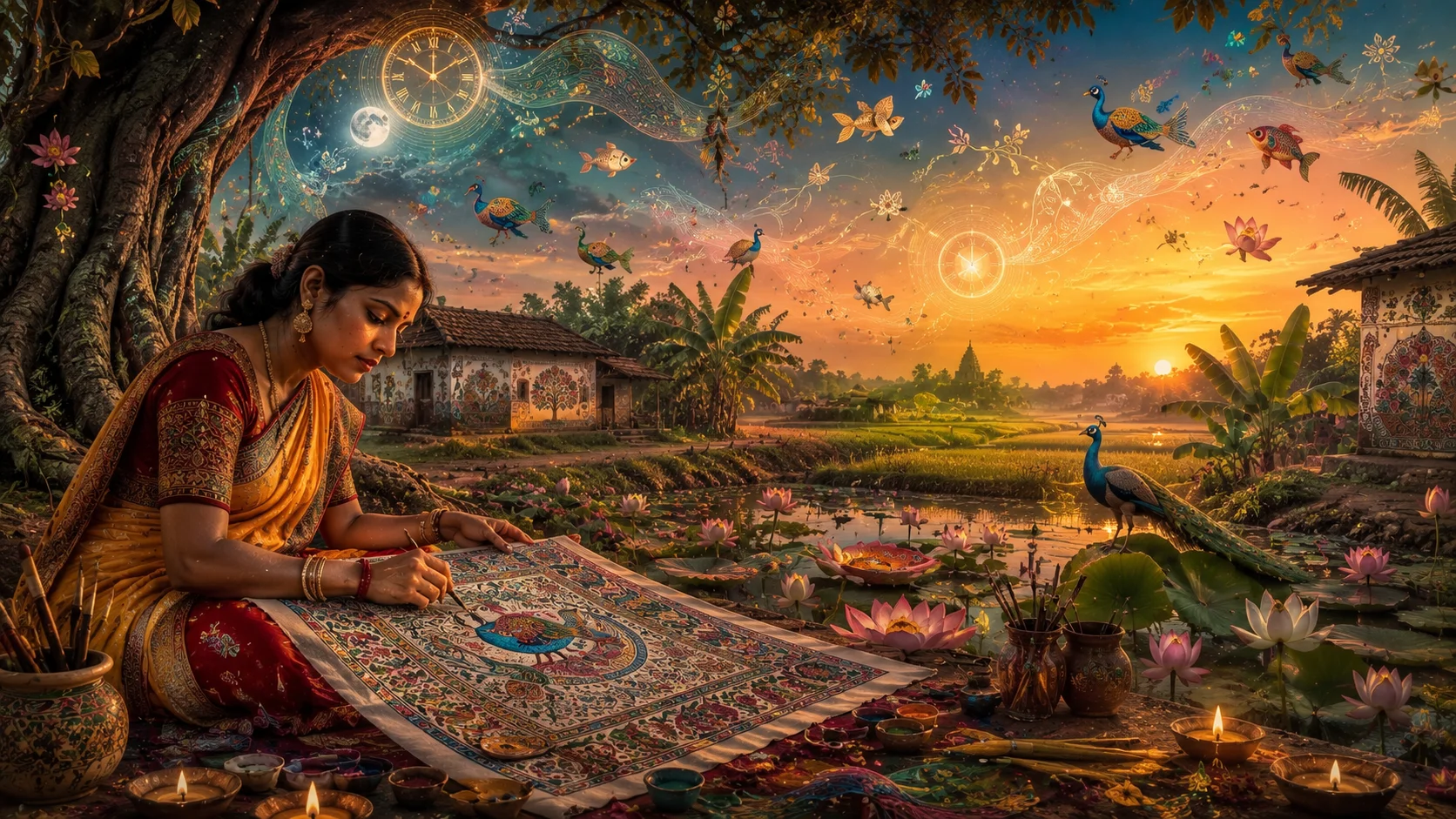
Have you ever paused to truly feel the wind, not just on your skin, but in your very soul? That whisper of change, the gentle breath that reminds us of life's fleeting yet profound moments? In the heart of Mithilanchal, where every stroke of a Madhubani painting tells a story, we have a concept for this – Ghari Pawan.
Ghari Pawan, in its essence, is not a specific motif or a particular style. Instead, it is a profound philosophical concept embedded deeply within the Mithila worldview and, by extension, in Madhubani art. It refers to the sacred rhythm of time, the *moment of the wind*, the transient yet deeply significant phases of life and nature that artists strive to capture. It's about recognizing the auspiciousness and interconnectedness of every passing 'ghari' (moment) and the 'pawan' (wind or breath) that carries the essence of life.
What is Ghari Pawan? Unraveling a Mithila Concept
In our Madhubani tradition, Ghari Pawan represents the interplay of time, destiny, and the natural world. It acknowledges that life is a series of moments, each carrying its own unique energy, like different winds that blow through our existence. It’s the belief that every season, every ritual, every birth, and every sunset holds a specific significance, a sacred 'ghari' influenced by the 'pawan' of cosmic forces.
For us, Ghari Pawan is about the cycles – the sun's journey across the sky, the moon's phases, the monsoon rains arriving right on time, or the auspicious moment a bride steps into her *kohbar* chamber. It’s a deep spiritual understanding that everything has its moment, its 'ghari,' and that moment is carried by the 'pawan' of the universe. This concept forms an invisible thread connecting countless Madhubani artworks, even if the viewer doesn't explicitly know the term.
"Each painting is a prayer, a capturing of a sacred ghari, carried by the pawan of our ancestors' wisdom. We don't just paint what we see; we paint what we feel, what we believe."
The Breath of Life: Ghari Pawan in Mithila Daily Life
The philosophy of Ghari Pawan is not confined to the canvas; it is woven into the very fabric of Mithila daily life. From the intricate *aripan* floor paintings drawn for festivals to the elaborate *kohbar* paintings adorning wedding chambers, every ritual is timed, every symbol chosen, to invoke the most auspicious 'ghari' and align with the 'pawan' of good fortune.
Consider our farmers in Madhubani district, Bihar. They know the Ghari Pawan of the monsoon, the exact moment the clouds gather, bringing life-giving rain to their fields. This awareness of nature's timing, its subtle rhythms, is deeply ingrained. And this understanding translates directly into our art:
- Harvest Scenes: Depicting the bounty of fields after a good monsoon, capturing a 'ghari' of prosperity.
- Wedding Rituals: The *sanjhi* painting of Radha-Krishna or the detailed *kohbar* walls, all created at specific, propitious 'gharis' to bless the union.
- Festival Celebrations: Illustrations of Chhath Puja, Diwali, or Holi, where the colors and motifs celebrate the energy of those particular 'gharis'.
These are not just pretty pictures; they are visual prayers, tangible expressions of a moment blessed by Ghari Pawan. The flowing lines of water in a painting, the birds in graceful flight, the swaying bamboo groves – all hint at the unseen 'pawan', the constant movement and energy of life.
How Madhubani Artists Depict Ghari Pawan: Styles and Symbols
As artists, we interpret Ghari Pawan through our choice of motifs, composition, and even the style we employ. The idea is to evoke the feeling of that sacred moment, that particular 'pawan'.
Bharni Style: Richness in Every Ghari
In the Bharni style, meaning 'filled,' we use vibrant, deep colors to completely fill the outlines. This richness and density often reflect a 'ghari' that is full, abundant, and deeply significant. Think of grand wedding scenes, lush depictions of deities, or nature in its full bloom. The intensity of color and intricate patterns convey the weight and importance of a powerful moment, a 'pawan' that is strong and transformative. It's about capturing the essence of a moment in all its glory and detail.
For example, a Bharni painting of a marriage ceremony might meticulously detail every ritual, every ornament, every expression, capturing the profound 'ghari' of two souls uniting. The entire canvas becomes a testament to that powerful Ghari Pawan, filled with symbols of fertility, prosperity, and joy.
Katchni Style: The Essence of the Fleeting Pawan
The Katchni style, on the other hand, relies on fine line work, cross-hatching, and minimal color. This delicate approach is perfect for capturing the ephemeral nature of 'pawan' – the wind itself, a fleeting moment, or a subtle emotion. The intricate lines, often in black or a single color, can suggest movement, lightness, and the transient beauty of life. It's about hinting at the essence rather than fully rendering every detail.
A Katchni painting might depict a lone bird soaring, its wings outstretched against a minimalist backdrop, symbolizing the freedom and fleeting journey of life's 'pawan'. Or perhaps a single dancer, her movements suggested by flowing lines, embodying the grace of a passing 'ghari'. Both styles, though distinct, serve to interpret the same underlying philosophy, showing the versatility of Madhubani art.
The Soul of Color: Natural Hues and Ghari Pawan
Our palette is not just about aesthetics; it's about connecting with nature, with the very elements that embody Ghari Pawan. For centuries, we have sourced our colors from the earth and plants around us, each carrying its own energy and meaning.
- Yellow from Turmeric (*Haldi*): Symbolizes auspiciousness, fertility, and the sun's life-giving energy – the 'ghari' of new beginnings.
- Red from *Sindoor* or Kumkum: Represents vitality, passion, and protection – the 'pawan' of strength and celebration.
- Blue from Indigo (*Neel*): Evokes the vastness of the sky and water, tranquility, and spirituality – the 'ghari' of introspection and peace.
- Black from *Kajal* or Soot: Grounds the art, provides definition, and protects against evil – the 'pawan' of stability and profound wisdom.
I remember as a young girl, sitting with my mother and grandmother in Ranti village, grinding turmeric roots on a stone to make that vibrant yellow. The air would be filled with its earthy scent. It wasn't just making paint; it was a ritual, a connection to the 'ghari' of our ancestors, a respect for the 'pawan' that sustained our art. These natural colors, applied with a simple bamboo pen, or *kalam*, breathe life into our interpretations of Ghari Pawan.
Preserving the Ghari Pawan: Challenges and the GI Tag
For us Madhubani artists, preserving this ancient art form, and the philosophies like Ghari Pawan that underpin it, is a lifelong dedication. But the path is not always easy. We face challenges from mass-produced imitations that lack the soul and authenticity, to the economic struggles of sustaining our craft in a rapidly changing world.
That's why the GI Tag (Geographical Indication Tag) awarded to Madhubani Painting in 2012 was a landmark moment. It officially recognized Madhubani as a unique product of our region, protecting its authenticity and preventing exploitation. It signifies that true Madhubani art, with its deep cultural roots and philosophical concepts like Ghari Pawan, can only originate from Mithila, particularly from the districts of Madhubani, Darbhanga, and others in Bihar. This GI tag helps buyers distinguish genuine work from fakes, ensuring the survival of this precious heritage.
Platforms like KalaVihar (kalavihar.com), founded by Prince Kumar right here from Madhubani, play a crucial role. They bridge the gap between us, the artists in villages like Jitwarpur and Ranti, and art lovers across the globe, ensuring fair prices and true recognition for our authentic work.
Embracing Ghari Pawan in Your Home: Beyond Decoration
When you bring a Madhubani painting into your home, especially one that subtly evokes the spirit of Ghari Pawan, you’re not just acquiring a piece of art. You are inviting a philosophy, a piece of Mithila’s soul, into your space. These paintings carry the energy of auspicious moments, the flow of nature, and the wisdom of generations.
Consider placing a painting depicting vibrant natural motifs – a pair of fish (*matsya*) symbolizing fertility, a lotus (*kamal*) for purity, or a peacock (*mor*) for love and wisdom – in your living room or a meditation space. These symbols, imbued with the spirit of Ghari Pawan, can bring a sense of calm, prosperity, and connection to nature's rhythms. Look for the intricate details, the natural color variations, and the story told through each line. Authentic Madhubani art is distinct; it has a texture, a depth, and an undeniable spirit that mass-produced items simply cannot replicate. KalaVihar guarantees this authenticity, providing a direct link to the artisans and their stories.
The subtle lines and vibrant colors will remind you daily of the beauty in every 'ghari', and the constant, gentle flow of 'pawan' that shapes our lives.
The concept of Ghari Pawan offers a unique lens through which to appreciate the profound beauty and wisdom embedded in Madhubani painting. It reminds us that art is not merely an aesthetic pursuit, but a reflection of life's deepest truths – the sacredness of time, the power of nature, and the enduring human spirit. When you gaze upon a Madhubani artwork, know that you are witnessing not just colors and lines, but the captured essence of a sacred 'ghari', carried by the 'pawan' of an ancient culture. I invite you to explore the authentic collection at KalaVihar, and find a piece that resonates with your own Ghari Pawan.